In this website, music notations are available in both Western Notations format (CDEFGAB) as well as classical Indian notations (Saregama) form. This is the western notations guide of HitXP. For the classican Indian notations format, please see classical Indian carnatic notation guide.
Western Notations Labels of an Octave
Below is the keys in an octave with the western notations label. The 7 white keys are C,D,E,F,G,A and B. The black keys are C#,D#,F#,G#,A#.
So in the song notations, in every place you see a C you need to press the first key of the octave. If you see D#, you need to press the second black key of the octave and so on.

Octave Number Recognition using Note Color
Now that we know which letter represents which note in an octave, we need a mechanism to understand which octave the note should be played in. As we can see in the above image, an octave has 12 keys (7 white keys and 5 black keys).
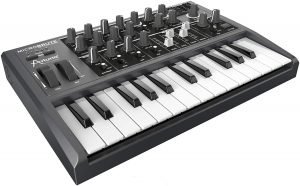
An electronic keyboard (synthesizer) will usually have anywhere between three to seven octaves. A piano will usually have 88 keys (7 octaves + 4 additional keys).
In HitXP.com we use color coded notations to represent octave numbers. In other words, the color of the notation text tells us which octave to play that note in.
Usually for most songs, 3 octaves are more than enough to play them. So we call them, the lower octave, the middle octave and the upper octave. Very rarely, two more octaves might be required. One below the lower octave, and one above the upper octave.

As you can see above, in the notations of HitXP.com, each octave is represented by a color as follows:
- C C# D D# E F F# G G# A B for Lower Octave
- C C# D D# E F F# G G# A B for Middle Octave
- C C# D D# E F F# G G# A B for Upper Octave
- C C# D D# E F F# G G# A B for Lower Lower Octave ie one octave below lower octave
- C C# D D# E F F# G G# A B for Upper Upper Octave ie one octave above upper octave
Indian Notations to Western Notations Mapping

Below is a mapping from Indian to Western notations in this website:
| Indian Notation | Western Notation |
| S | C |
| r | C# |
| R | D |
| g | D# |
| G | E |
| M | F |
| m | F# |
| P | G |
| d | G# |
| D | A |
| n | A# |
| N | B |
The above notations are the same for all octaves.
Alternate Indian Notation System to Western Notations
Below is the old Indian notation format that was used in this website, but is not used any more. So this is useful only if you find this format used on any other website in the internet and want to understand the mapping to western notations. Otherwise, you can ignore rest of this article.

Middle Octave – Keyboard / Piano Notation Symbols mapping Indian to Western System
Below is a mapping of the middle octave notations from classical Indian system to the corresponding Western Notations.
| Swara | Octave Key Position | Carnatic Notation | Western Notation |
| Sa | 1st white key | s | C |
| Ri | 1st black key | r1 | C# |
| 2nd white key | r2 | D | |
| 2nd black key | r3 | D# | |
| Ga | 2nd white key | g1 | D |
| 2nd black key | g2 | D# | |
| 3rd white key | g3 | E | |
| Ma | 4th white key | m1 | F |
| 3rd black key | m2 | F# | |
| Pa | 5th white key | p | G |
| Da | 4th black key | d1 | G# |
| 6th white key | d2 | A | |
| 5th black key | d3 | A# | |
| Ni | 6th white key | n1 | A |
| 5th black key | n2 | A# | |
| 7th white key | n3 | B |
Higher Octave – Keyboard / Piano Notation Symbols mapping Indian to Western System
Below is a mapping of the higher octave notations from classical Indian system to the corresponding Western Notations.
| Swara | Octave Key Position | Carnatic Notation | Western Notation |
| Sa | 1st white key | S | C+ |
| Ri | 1st black key | R1 | C#+ |
| 2nd white key | R2 | D+ | |
| 2nd black key | R3 | D#+ | |
| Ga | 2nd white key | G1 | D+ |
| 2nd black key | G2 | D#+ | |
| 3rd white key | G3 | E+ | |
| Ma | 4th white key | M1 | F+ |
| 3rd black key | M2 | F#+ | |
| Pa | 5th white key | P | G+ |
| Da | 4th black key | D1 | G#+ |
| 6th white key | D2 | A+ | |
| 5th black key | D3 | A#+ | |
| Ni | 6th white key | N1 | A+ |
| 5th black key | N2 | A#+ | |
| 7th white key | N3 | B+ |
Lower Octave – Keyboard / Piano Notation Symbols in Indian Carnatic System
Below is a mapping of the lower octave notations from classical Indian system to the corresponding Western Notations.
| Swara | Octave Position | Carnatic Notation | Western Notation |
| Sa | 1st white key | s | C- |
| Ri | 1st black key | r1 | C#- |
| 2nd white key | r2 | D- | |
| 2nd black key | r3 | D#- | |
| Ga | 2nd white key | g1 | D- |
| 2nd black key | g2 | D#- | |
| 3rd white key | g3 | E- | |
| Ma | 4th white key | m1 | F- |
| 3rd black key | m2 | F#- | |
| Pa | 5th white key | p | G- |
| Da | 4th black key | d1 | G#- |
| 6th white key | d2 | A- | |
| 5th black key | d3 | A#- | |
| Ni | 6th white key | n1 | A- |
| 5th black key | n2 | A#- | |
| 7th white key | n3 | B- |